Showing posts with label Tan. Show all posts

Problems downloading apps & games in your Android Phone?

Tuesday, November 18, 2014 by Tan
Problems downloading apps & games in your Android Phone?
Do you see an error message, telling "Insufficient Storage" when trying to install updates or new apps in your Phone? Try the following steps to remove the error message:

1. Tap Menu > Settings > Applications > Manage Applications
2. Go to "All"
3. Scroll down to "Google Play Store" and tap to select it.
4. Click on 'Force Close'
5. Click on 'Clear Data'
6. Click on 'Uninstall Updates'
7. now it is safe to click on 'continue' when u open the market..so go ahead.
8 Enjoy Installing/Updating your desired apps.


Now, you will be able to install new apps or update the existing games/apps.
Posted in Labels: , , | 0 Comments »

Weather forecast in Microsoft Office Outlook 2013 Calendar

Wednesday, June 19, 2013 by Tan
Welcome to Microsoft Office 2013. Have you guys used it yet? I am sure most of you might have used it already. How are you feeling after using the latest version of MS Office? Well, I am very happy with it as of now.

One of the features that I found great and was missing in the earlier versions of the Microsoft Office Outlook is Weather forecast in the Outlook Calendar. It looks like this:


When you open the calendar in your Microsoft Office Outlook 2013, you will find this weather bar, where you can see the weather of today and forecast for the next two days, as default. Check it out, if you have not seen it yet.

You can add new locations, based on your needs and can select anyone at one time. Every time you open calendar in Microsoft Office Outlook 2013, you will be able to see the weather bar. Apart from the maximum and minimum temperatures, it also tells you about the Average Wind Speed, Humidity, and Precipitation and, whether the day will be cloudy, sunny and rainy or anything else. I quickly set it to the city I stay in and it gives me the information quickly.

However, one thing I could not get at the first attempt was to change the temperature units – degree Fahrenheit (which is default) to degree Celsius (which we follow in our country). After going through a few trial and errors, I got to know how to change the temperature units from degree Fahrenheit to degree Celsius. So, here are the steps that you can follow to do so:


In Microsoft Office Outlook 2013, click on File.


Now, choose Options from the drop menu.


Then, click on Calendar in the Outlook Options window. Once you are in the Calendar options, scroll down to the extreme down where you will find the sub heading ‘Weather.’ Here, you can choose which temperature unit is to be displayed - degree Fahrenheit or degree Celsius.


You can also disable the weather on your Microsoft Office Outlook 2013 Calendar here, but that would be little foolish to do – even if you do not use it, why not keep it there, in case you need it sometime, for a quick update or such…

Hope you liked this. Let us know, if you got benefitted by this article.

Cheers!
Posted in Labels: , , | 0 Comments »

What is a file with extension XLK?

Tuesday, April 3, 2012 by Tan
I was working on MS Access and had to export a table to an excel workbook. This happened nice and fast. Then, I opened the workbook and made some changes and when I closed the workbook, I found another file in that folder. See below:


This is something new to me. The new file created was of the same size as the original size and it said that it’s a backup file. I did not want that to happen and so, I searched and found out things about XLK files.

The backup file that was created was an XLK file. XLK file extensions are associated with MS Excel and not MS Access, as I initially thought. These files are used to create backups of the normal XLS or XLSX files. These backup files carry the data and formatting that the originals had just before they were saved for the first time.

It is not easy to create such files in MS Excel as this option is not a default one. However, when a new excel workbook is created from MS Access, the file is saved with an optioned enabled, which creates backups automatically when it is saved.

Now, how to create a MS Excel workbook which will keep on taking backups? Here is it, for computers running MS Office 2007.


We need to save the file once more, this time, choose ‘Save As…’ option, instead of a simple Save. When you have the ‘Save As…’ dialog box open, click on the small down arrow in the Tools button and choose ‘General Options.’


In the new window that appears, check the option ‘Always create backup’ to enable automatic backing up of your MS Excel file.

Now, when you open this file, make some changes and save it, the backup file, with the XLK extension will automatically be created. However, this option does not change how your MS Excel behaves, but is specific to that one file, in which you have enabled this option.

If you have MS Office 2003 installed in your computer and you want it to create similar XLK files when you save them, click on File, go to ‘Save As…’ and then go to Tools and finally you will find ‘General Options’ present in there, where you can check the ‘Always create backup’ checkbox.

While searching, I landed up in a website, which felt nice. It started with saying:
Backup your files, always take backups Three things are certain: Death, taxes, and lost data. You can put them off but you can’t eliminate them. The only difference between a good hard drive and a bad hard drive, is that the good hard drive hasn't crashed yet.

Check this out. They talk about the advantages of backing up your data.

Cheers!
Posted in Labels: , , | 0 Comments »

How to open MDI or TIFF files using Microsoft Office Document Image Writer?

Tuesday, February 14, 2012 by Tan
Hello mates,

It has been long time since I logged in here and wrote something that can be useful to the world. Hope everything is going great with you and your friends and family. With me, everything was going fine, until recently, I ran into a problem with my computer. I had a file with the extension MDI and I was not able to open that file to view it. It was a picture file and I had some serious business with it, but my computer would not let me open it.

I did some good research on this topic in Google and could, at last, find a way to open and view the file. My job was done all right, but I wanted to share this with you too, so that it helps should you run into such a situation and know not what to do.

Excuse me for not writing this any earlier, for I have had this issue some time back. However, now I am in mood and this is the reason, I am writing or rather describing the way I got it resolved. Hope it helps you too.

Well, to open MDI or TIFF files in your computer, you would need Microsoft Office Document Image Writer, a print driver included in the Microsoft Office suit itself, unless you have any other software to view these files. Microsoft Office Document Image Writer print driver is a part of Microsoft Office Document Imaging, in the office suit and it should get installed when you install the office suit entirely. Many of us install the suit in typical mode or in custom mode and fail to include this ad on. This is when you might run into the problem of viewing MDI and/or TIFF files.

I will tell you how to enable or install Microsoft Office Document Image Writer print driver in your computer, but let me tell you first what these MDI or TIFF files are.

Microsoft Office Document Imaging or MDI Format is a high resolution, tag-based graphics format which is used for digital graphics. At times, when you scan a document, it might get saved in this format.

TIFF or Tagged Image File Format is again, a high-resolution, tag-based graphics format which is used for the exchange of digital graphics, mostly in black and white, globally.

So, to open and view these high resolution image graphics files, you would need Microsoft Office Document Image Writer print driver installed in your computer, unless as I said earlier, you have some other software to do so. To install Microsoft Office Document Image Writer print driver in your computer, you may do the following things in order:

Note: I am using Microsoft Office 2007 version in a computer running on Microsoft Windows XP (SP3), and hence, the screenshots would tell you the same…

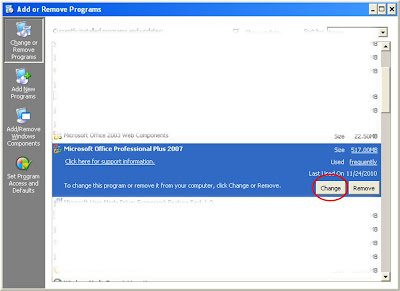
Step 1: Go to the Add or Remove Programs in the Control Panel of your Windows XP PC. You can press Windows Key and R together to open Run window and there, type control and press enter to open Control Panel. Or else, you can type appwiz.cpl to open Add or Remove Programs utility directly.

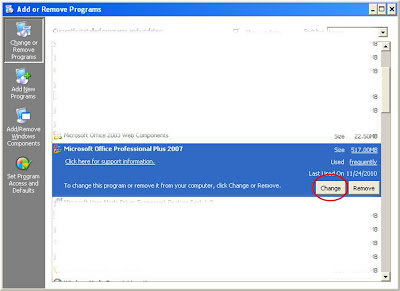
Step 2: Once you are there in the utility, scroll down and locate the MS Office Suite and shown below and click on Change option.


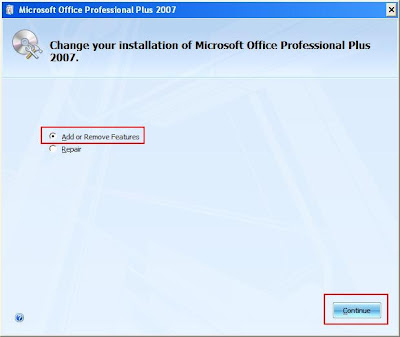
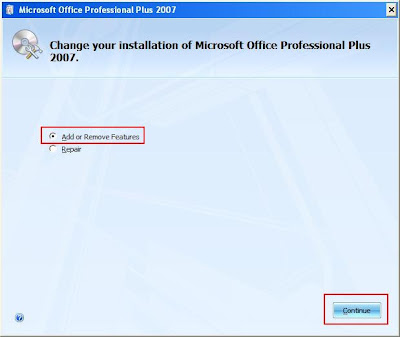
Step 3: In the next window, select Add or Remove features and click on Continue.


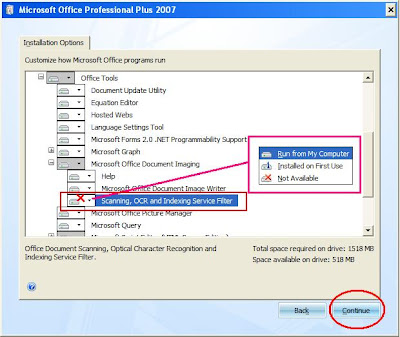
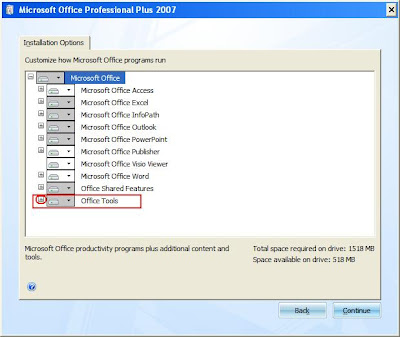
Step 4: In the next window, expand Office Tools in the Installation Options.


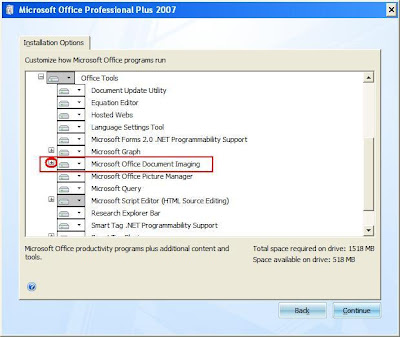
Step 5: Then, expand Microsoft Office Document Imaging option.


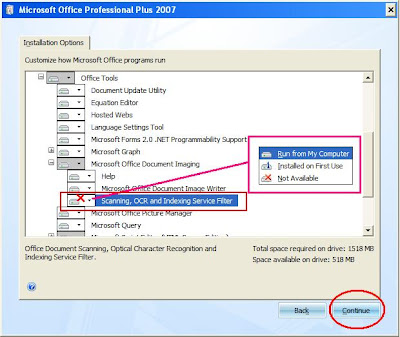
Step 6: Now, click on the Scanning, OCR and Indexing Service Filter and choose Run from My Computer option. Click on Continue.


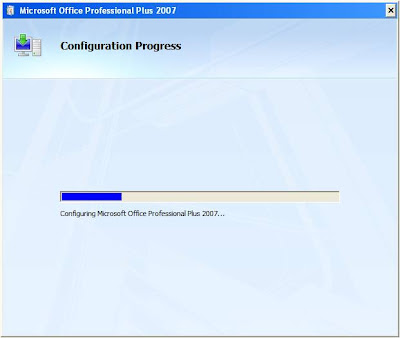
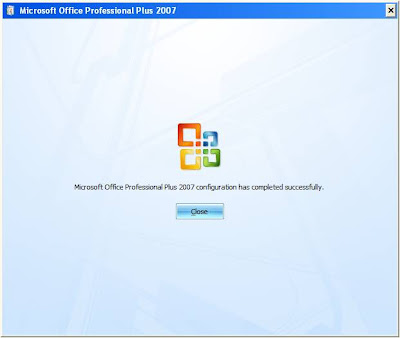
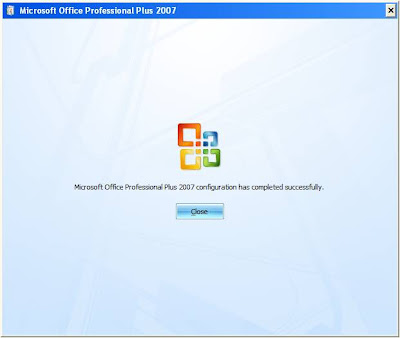
Step 7: System will configure itself and give you a success notification.


That’s it!

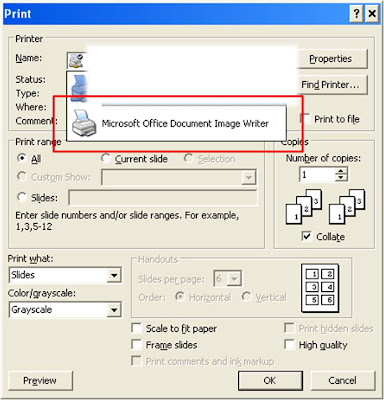
Once this is done, you can find Microsoft Office Document Image Writer option in the list of Printers installed in your computer.
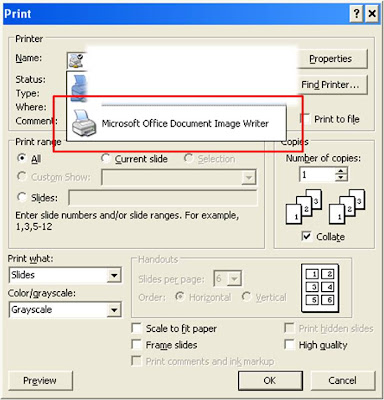


Let me know if this helps, so that I would know. If you need anything else, do let me know that too.

See you next time; till then, keep fit and have fun with codes, windows and your computer!


And yes, Happy Valentine's Day!
Posted in Labels: , , | 0 Comments »

Automation decreases Cycle Time

Wednesday, May 18, 2011 by Tan
Automation using Excel macros is finding its deserving position amongst many businesses. This article talks about the benefits that automation using Excel macros brings to a business.


Excel macros have proved over the last few years that technology driven automation of regular and repetitive works can reduce the turnaround time, increase productivity and will always ensure better quality and hence, benefit business.

In reporting and analysis sector, we come across huge data that has to be processed, analyzed and employed daily to get analysis and reports that impact our business. There exist huge amount of repetitive work that is also time taking, prone to manual errors and in terms of quality are nothing but a waste or Muda. Automation of these reports can complete the entire process quickly and hence, can easily reduce the turnaround time. Excel macros are the perfect automation tools that we can get in a reporting and analysis environment. They can help us not only in getting the process done quickly, but also can eradicate human errors. With zero human errors we do not waste time on re-work and hence, a lot of direct and indirect resources are saved. This has a direct impact on our business.

Excel macros show us how technology benefits business. This technology has changed the way one used to look at raw data that has to be analyzed and converted into useful business information. Loads of data can now be processed within minutes using Excel macros and the analysis becomes easier, with zero error and better quality data. These macros can be run from any machine and by anyone and a business utilizing this technology can reduce the overall headcount too. Automation using Excel macros can do the job otherwise manually done by many employees, with a quality output, zero errors and within a faster turnaround time. When the cycle time is reduced and you do not need to worry about doing a re-work on the project, you can rest assured that this will technology will benefit the business in both monetary terms and in gathering better customer satisfaction.
Posted in Labels: , , | 0 Comments »

Happy New Year 2011

Saturday, January 1, 2011 by Tan
A small message to all my readers. Wish you all a very happy and prosperous New Year. May this New Year bring you health, joy and prosperity. May God bless you with all that He has for you. This new year, let us take a pledge to make this earth a better place to live in. Let us move from darkness to light, from lies to truth and from death and stale living to a vivid and constructive life! May all of you have a great year ahead.

Happy New Year 2011. Let us welcome the new year with a smile on our faces.

God Bless!
Posted in Labels: , | 0 Comments »

How to open MDI Files in Microsoft Office 2007

Wednesday, December 22, 2010 by Tan
Today, when I tried to open a file with the extension .MDI, I could not open it and could not find a software application in my computer which would open it. I searched a long and finally I got to know what I had to do. Let me share with you here and tell you how you can open files with .MDI extension in a computer running Microsoft Office 2007.

What is a MDI file? MDI stands for Microsoft Document Imaging, which is a proprietary image format from Microsoft. Scanned images are stored using this format. One needs to have Microsoft Office Document Imaging installed in the computer to open and view files with MDI extension. This is an application that comes along with the MS Office suit.

The issue with this application is that it gets installed automatically along with Microsoft Office 2003 suit; however, the same is not true with the later versions of the software. My problem was that the file I wanted to view was created in a computer running MS Office 2003 and I am running MS Office 2007 in my computer. Hence, to open MDI Files in Microsoft Office 2007, I had to install that application in my computer. Once done, it opened smooth and I could print!

Let me tell you how you can install Microsoft Office Document Imaging in your computer, running on MS Office 2007. The steps are simple, but most users would find it little difficult since there are some steps involved in that. Hope I can explain the steps better here.

Operating System: MS XP
Office version: 2007


To view MDI Files in Microsoft Office 2007 we need to first install the application.
To do so follow the steps below:
1. Click on Start.
2. Click on Control Panel.
3. Double Click the Add or remove programs icon.
Alternately, type appwiz.cpl in Start > Run and hit Enter.
4. As the dialog box comes up, select Microsoft Office 2007 (as per the version installed in your computer).
5. Click on Change button.

6. You will get a dialog box from MS Office asking you to either add or remove features, repair and uninstall (may not be present in all computers).
7. Choose Add or Remove features option, and click Continue.

8. In the next screen expand Office Tools, by clicking on the small plus sign. 9. Similarly, expand Microsoft Office Document Imaging option, inside Office Tools.
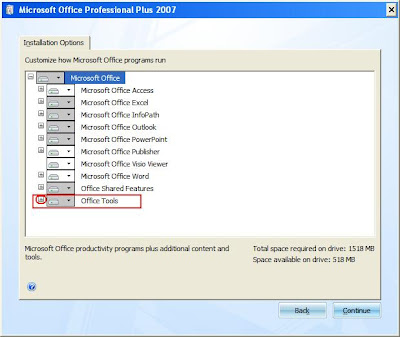
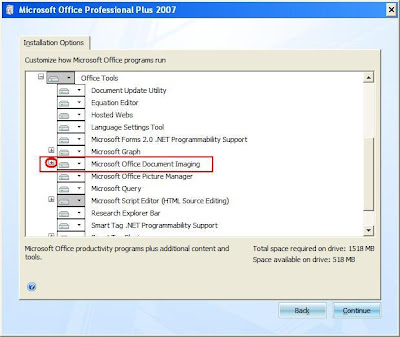

10. Now, choose Scanning, OCR, and Indexing Services Filter, and then click on the small down arrow.
11. Select Run from My Computer option and click on Continue.


This will start configuring your computer and installing the application and you will see a screen like this:

This ends the installation.


Now, to check whether the installation was successful, try printing any document. You will find an additional item named, ‘Microsoft Office Document Image Writer’ as a virtual printer installed along with the pre-installed printers in your computer. This confirms that the application is installed and now you can print any document and save it with .MDI extension. On top of that, you may now open any MDI files sent to you from any other computer.


This thing is very helpful, when you collect documents from the internet and want to print it later. Also, you may use this when you want to move a document to another computer before you would like to print. This will save you some time and would result in a nice printing solution. Now you know how to open MDI Files in Microsoft Office 2007 and you need not run around searching for computers or applications that can open and MDI file.

For a detailed article on MDI file formats and the above steps in computers with other versions of MS Office, please see this web document from Microsoft.

Hope you liked this post. We appreciate your comments. Please feel free and let us know if this was helpful. Merry Christmas. Enjoy!

Posted in Labels: , | 0 Comments »

Introduction to Macros for MS Outlook

Wednesday, November 3, 2010 by Tan
Hello!

I am here again today with another introductory post. Hope you are enjoying the series and using the information shared here. Today, I will introduce Macro for Microsoft Office Outlook. This is interesting, as we would all like someone to check our daily emails, put those emails into different folders, sort them on our requirements and probably compose and email a reply to the sender with the adequate information. Yes, all these are possible in Outlook itself and whatever is not already present, can be achieved using a bit of VBA coding or using Macros. Macros in Outlook are fascinating and today I will show you a simple macro which will tell you when an email lands up in your mailbox.

Open Outlook and Hit Alt + F11 to open the VBA Editor. This is what you do to open the editor in any Microsoft Office Application. Once in the editor, add a new module and type in this text below:

Sub MsgAlert(NewMail As Outlook.MailItem)
MsgBox "You have got a Mail."
& vbCr & "Subject: " & NewMail.Subject & vbCr & "From: "
& NewMail.SenderName & vbCr & vbCr & "It Says:- " & vbCr
& NewMail.Body, vbInformation, "Attention!"
End Sub

This will tell you with a message box telling about the new email that has landed in your inbox with fields like, Subject, Sender Name and the Content of the email. Now, you may add a rule to call this Macro or just modify an existing rule to incorporate this script. To know about Rules and Alerts in Outlook, visit this link.

Macros in Outlook can also be used to automate any task that you perform over and over again. Like sending an End of Day Report Notification or may be responding to specific email lists etc.

To know more about Codes in outlook, you may also visit this exciting website:
http://www.outlookcode.com/

Do let me know how it went. Till then, cya!
Posted in Labels: , , , | 0 Comments »

Introduction to VBScript

Tuesday, October 26, 2010 by Tan
I am here today to give you a heads up about VBScript. What are VBScripts? As the name suggests, this is a script version on Visual Basic or VB. We can hence say that Visual Basic Script is a subset of the Visual Basic language.

VBScript is also a scripting language that can be used as an alternative to Java Script that runs in Internet Explorer for Windows OS. What is the relation between Internet Explorer, Windows Operating System and VBScript? Yes, you guessed it right. It is a scripting language supported freely on Windows OS and IE, and all of these are developed by Microsoft. Hence, you can see that VBScripts work only on a Windows hosting platform.

One advantage with VBScript for those who are already familiar with Java Scripts is that VBScript and Java Script blocks can be used together in one document, and functions, statements and variables in these blocks can be related to one another.

The applications written using VBScript are saved as .VBS files that can be executed with either WSCRIPT or CSCRIPT. These two are nothing but Windows Scripting Host programs. VBS applications can execute on computers where Microsoft Windows OS is installed, using these Windows Scripting Hosts.

To know more about VBScripts, feel free to visit the Wikipedia Link. It gives you good insights about the language, its history and much more.

Try this simple code. This will give the squares of first five digits:
Paste the following codes in between < type="text/vbscript"> and < /script >


Dim sText(5)
For i=1 To 5
sText(i)="Square of " & i & "is: " & i*i
Next


For i=1To 5
document.write(sText(i) & " ")
Next


Simple huh! If you want to see a bit more complicated one with some user interface, just replace statement 8 above with the following statement. It asks for 5 phrases one after the other and once you input them, they will show the result in a list.

sText(i)=inputbox("Enter Phrase # " & i)
Try this with names of books, friends or anything that you want and see VBScript in business.

PS: You may add a tag <> at the top and < /html > at the end and save the file as a html file and run it using Internet Explorer. This also works that way. Let me know you are reading. Do comment in your views...
...

Calculate Age in Excel without VBA

Wednesday, October 13, 2010 by Tan
Hi Friends,

How is life?

Ever wanted to get the Age of a person in Excel? Yes, often we come across a situation when we need to calculate that. I am sure using Excel VBA, it will be very easy; however, I will show you a way to get the results, in Years, Months and Days without using VBA. Sounds good, right? OK then... Check this out:

We need to know the date of birth of the person to calculate his or her age, right? Given that the date of birth of the person is in cell A1, we can use the following formula to calculate his age in excel:


=DATEDIF(A1,TODAY(),"y") & " years " & DATEDIF(A1,TODAY(),"ym") & " months " & DATEDIF(A1,TODAY(),"md") & " days "

We might use this formula while calculating the age of a person in excel 2000, 2003, 2007 and even 2010. The same formula works. I like this, because it uses a function DatedIf which we normally do not use; and all of it is done without using VBA.

Try this out and let me know...
Posted in Labels: , | 2 Comments »

Open and Close Folder or File with VB or VBA

Thursday, July 29, 2010 by Tan
Hi Folks!

There are two new things that I learnt while coding in VBA today and I thought of sharing the same with you!

Ever wanted to open a directory or folder somewhere in the computer from within the code you write? Well, some you might have wondered how to do that; and to others, who have not tried it, it would sound rather interesting. Here is one way that you can do this. To open a folder called Code present in your C Drive, you can use the following code:

Sub OpenDir()
Call Shell("Explorer C:\Code, vbNormalNoFocus)
End

Yea, that is all it is! Simple, right? I felt so, after some good time spent on it.

Here is the next one. We all use Alt + F4 to close a file, a folder, Windows Sessions or even the application that we are working on. How to do that from within your script? Well, here we are trying to replicate the key press combination: Alt + F4; and not just a close syntax. Heard of the command SendKeys? Here is one way to do that:

Sub PressKey()
SendKeys "%{F4}"
End

Or if you want a question before you close:

Sub PressKey()
Dim iX As Integer
iX = MsgBox("Close?", vbQuestion)
If iX = vbOK Then
SendKeys "%{F4}"
End If
End

Hmmm. I found it interesting! Go ahead and try different things with SendKeys and I am sure you will discover something more, for sure. Also, let us know if you have some specific queries related to the above two commands. We will try to dig into it. Keep coding – keep learning and do not forget to share what you have got.

Let us learn and grow together!
Posted in Labels: , , , | 0 Comments »

Introduction: Scripting in Avaya

Saturday, April 3, 2010 by Tan
First of all, let me tell you that this post is relevant only to the users of Avaya and one who has not used the machine or the software associated with the same may find all this Greek.

A lot of people who use Avaya Call Management System in their day to day life to extract Avaya Telephony data would know the pain involved in extracting data on half hourly, hourly, daily or weekly basis for each split skill they are involved in. If one needs to extract hourly data for a week’s period for 10 split skills, it would mean login into Avaya and after selecting the right view set, one would put in split skill info 24 × 7 × 10 = 1680 times to extract as many dumps. This, considering you need to put only one variable in your query while extracting data.

Just think of a situation, where you are having lunch and someone is extracting the data and saving the dumps with a right naming convention in your computer. You come back and see all the data there – all you need to do is to consolidate those and se the report that you want to. And if you have another macro for consolidating the dumps the way you want, that would be more like it!

Well, while consolidation of data needs to be done on our own, extraction of data is possible with Avaya Scripting. Avaya provides an option to extract and save the dumps based on auto generated scripts. Depending on the view sets chosen and the types of data needed, Avaya generates a script on its own while extracting the dumps. If this script is saved and run at a later stage, the same dump will be extracted, generated and saved in your local computer. All this without having to login to Avaya CMS and putting the variables manually!

This introduction to Avaya Scripting does not have the scope to tell about the same in more details; however, watch this space for more on Avaya, Avaya Scripting and the tweaks that would be necessary to achieve complete automation of Avaya. We will explore more into Avaya and everything that is possible with Avaya Scripting.
Stay tuned!

Welcome to Microsoft Office Applications.

Wednesday, March 3, 2010 by Tan
Welcome. Microsoft Office includes a wide range of Applications that can be used for a wide range of activities required in your daily life or at work. There are many office tools available to an user – few that are free and lots that are not; however, MS Office has grown and maintained their usage and popularity among users all over the world.

Well, this blog is not an agency to promote MS Office in any way, but to re-iterate, we will be talking about codes and scripting which would find their extensive use in these office applications. So, why not start with a small introduction to the same. This is where the codes we discuss in the blog will find their use. Most of the readers of The Code Point would know about MS Office and its basic applications. We can assume it correctly as because if the user have not used it earlier, he would not find the need of searching for codes that are required in these applications. Anyways!

Microsoft Office comes with an online resource of free training which talks about basics of these Office Apps and shows a way to the reader where he can walk on. I have myself used these tutorials many a times, while using MS Word 2003 and MS Excel 2003 and more now, when we are working on MS Office 2007. Feel free to visit the following web link and go through the various free training courses. These courses are self paced and talks about almost all necessary amendments and dissimilarities of an old and new version of MS Office App.


Note: If you want something more in those training courses apart from what is listed in the front page, please use the ‘Search Training’ tool at the top of the page.

Well, I was going through a lesson sometime ago and I really loved the way they told about ‘Nested Loops’ used in VBA. Check the following:

Do While (Earth Revolves around the Sun)
    Do While (Earth Rotates around its axis)
        If (Facing Sun) Then
            Day
        Else
            Night
        End If
    Loop
Loop
Quote: OK, so the code above wouldn't actually run in Excel, but it illustrates that for each big loop (around the sun) there are 365 smaller loops (around Earth's axis).

How easy to understand and simple is that? I just loved it. Teaching has to be thus. Simple, easy and to the point! This is the reason I would recommend the reader to go through the material there in free time (even if you consider yourself to be advanced and have no time) and I am sure you will see things that might have missed your eyes!

Best of Luck!
Posted in Labels: , , | 0 Comments »

Lets Learn and Grow together!

Saturday, February 20, 2010 by Tan

Welcome to The Code Point.

If you look at the Establishment date at the right, you will find a huge gap between that day and the day you see the first post on this blog. Yes! Three years! This blog was initially built with an aim to put all my programming ideas and software. Well, I will do the same from here onwards too, but the motive has changed a bit. Now, it will be more of sharing and a two way learning process, where the reader also come up and contribute in the same.

Wish us luck! Wish us all the good things in the world, that can bring some fortune to this blog. All what we want is am interactive blog where you not only learn, but also get a chance to share your own knowledge.

So fasten your seatbelts. Get ready for a joy ride. What we would look forward to is your feedbacks and your contribution to the blog. Come with an open mind and browse the ever increasing realm of Scripting, Macros and Programming as a whole. 

Lets learn and grow together!
Posted in Labels: , | 0 Comments »